Stuck
Why nothing changes when you already know what to do
You could write down the answer right now. You have been able to for months. The thing standing between you and it is not information, and treating it as though it were is why another year went past.
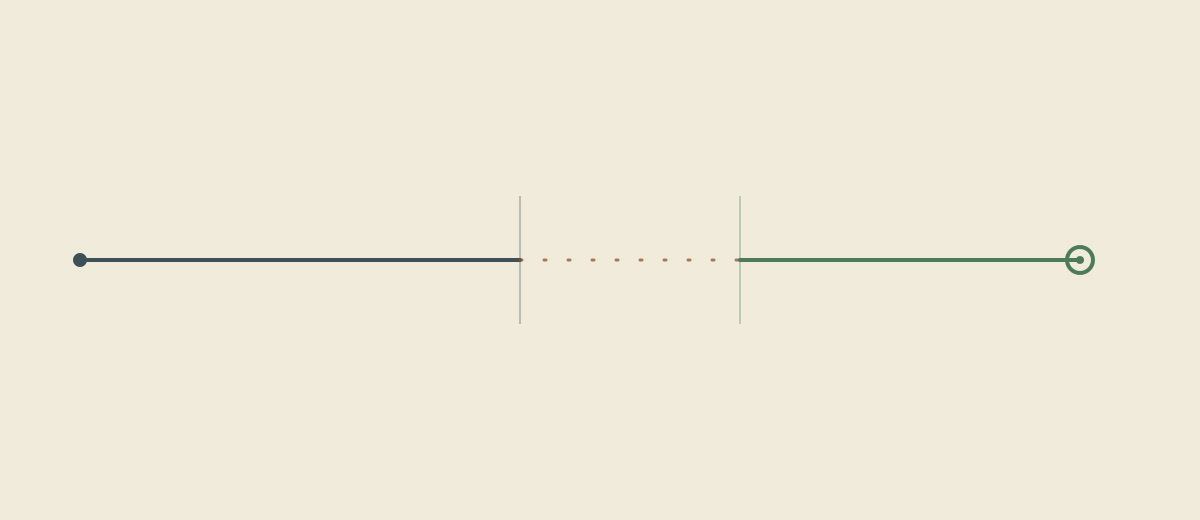
Ask most people what would make their life better and they answer in about four seconds. Leave the job. Have the conversation. Stop drinking on weeknights. Go back to the gym. Finish the thing that has been at ninety percent since March.
There is no confusion. That is what makes it maddening. If you were confused you could go and find out, and finding out is a thing you already know how to do. Instead you are in the odd position of watching yourself not do something you have already decided to do, which feels less like a problem to solve and more like a character flaw to hide.
It is not a character flaw. It is the most studied gap in behavioural science, and knowing its shape helps, because the shape tells you where the lever is.
The gap has a name and a size
Psychologists call it the intention behaviour gap. It is the distance between what people sincerely intend to do and what they actually do, and it has been measured across hundreds of studies on exercise, diet, medication, saving money and quitting things.
The headline finding is brutal and worth sitting with. Across the literature, a large shift in someone's intentions produces roughly half that much shift in their behaviour. People who fully intend to act fail to act about half the time. Not people who were unsure. People who had decided.
Deciding is not a small version of doing. It is a different act, and doing it well has almost no effect on whether the second one happens.
This is why the advice industry mostly fails its customers. It sells more deciding. Another framework, another list, another video that makes you feel, for about forty minutes, like this time is different. All of it operates on the half of the problem that was never broken.
Why more information makes it worse
There is a specific trap here and it is worth naming, because almost everyone who is quietly stuck is sitting in it.
Reading about the change feels like progress. It produces the same warm sense of movement that actual progress produces, at a fraction of the cost, with none of the risk. So the honest accounting is that research has become the thing you do instead of the thing.
Worse, it raises the bar. Every article you read adds a condition. Now you need the right morning routine first, and the right system, and to understand why you are like this, and to have the energy, and to wait for a quieter month. A decision that was one step in January is a project by August, and projects can be postponed indefinitely without anybody noticing, including you.
What actually closes it
Three things have real evidence behind them. None of them is inspiring, which is roughly the point.
1. Turn the intention into a time and a place
"I will exercise more" is a wish. "I will walk for thirty minutes at seven on Tuesday from my front door" is an instruction. The technical name is an implementation intention, an if then plan that names the situation and the action together.
The effect is one of the more reliable findings in the field. A meta analysis covering ninety four independent tests found a medium to large improvement in goal attainment from this alone, from nothing more than writing the plan in that form. It works because it removes the moment of decision. You are not choosing at seven on Tuesday. You already chose.
2. Make the next step embarrassingly small
Not because small steps are magic, but because the size of a step is what you negotiate with when you are tired. A big step invites a negotiation you will lose at the end of a bad day. A step small enough to be ridiculous does not.
The test: could you do it badly, in ten minutes, while unmotivated? If not, it is not the next step, it is the goal wearing a smaller coat. Break it again.
3. Have somebody who will ask
This is the one people resist, and it is the one that does the heavy lifting.
A private commitment has one witness, and that witness is also the person who most wants to be let off. It costs nothing to quietly drop. There is no moment where the dropping becomes a fact, because nobody says the words out loud.
Say it to somebody who will follow up and the whole structure changes. Not because you fear their judgement. Because a date exists at which the question gets asked, and that turns a vague intention into something with an edge on it. The uncomfortable half hour before that conversation is where a surprising amount of life actually gets done.
The version you can do tonight
- Write the one sentence. Not the goal, the next action.
- Put a day and a time on it. An actual clock time.
- Cut it in half. Then cut it in half again.
- Tell one person who is likely to ask you about it on Friday.
The part nobody puts in the article
Sometimes the reason you are not doing the obvious thing is that the obvious thing is not what you want, and you have not admitted it yet.
Somebody who has been meaning to apply for jobs for a year may not have a motivation problem. They may have a problem where the honest sentence is "I do not want another version of this job, I want out of this field entirely", and that sentence is expensive, so it stays unsaid, and in the meantime a fake goal absorbs all the guilt.
This is worth checking before you build systems around the fake goal. Ask yourself what you would do if the thing you keep failing to do turned out to be optional. If the answer arrives instantly and with relief, that is your information.
What this comes down to
Nothing changes because deciding and doing are separate acts, and you have been doing the first one repeatedly, at higher and higher quality, hoping it would eventually turn into the second.
It will not. What turns it into the second is a specific action, at a named time, small enough to survive a bad day, that somebody is going to ask you about.
The asking part is the hard part to arrange
Most people can write the plan. What they do not have is anyone whose job it is to remember what they said and come back to it. Friends are kind and they forget. Clarior is a coach: it learns your situation properly, sets you work between sessions, and picks up exactly where you left off, including the thing you were hoping it had forgotten.
It is deliberately hard to start, because we would rather have fewer people who are in the right place.
See whether it is for youSources
- Sheeran, P. and Webb, T. L. The Intention Behavior Gap, Social and Personality Psychology Compass, 2016.
- Webb, T. L. and Sheeran, P. Does changing behavioral intentions engender behavior change? A meta analysis of the experimental evidence, Psychological Bulletin, 2006.
- Gollwitzer, P. M. and Sheeran, P. Implementation intentions and goal achievement: a meta analysis of effects and processes, Advances in Experimental Social Psychology, 2006.
- Locke, E. A. and Latham, G. P. Building a practically useful theory of goal setting and task motivation, American Psychologist, 2002.
This article is general information, not medical advice. If you are struggling in a way that goes beyond feeling stuck, speak to your doctor.